Pages

Wednesday, December 3, 2014

"Our revels now are ended:" Looking Back on the Semester

As the semester draws to a close, it only seems fitting to look back on what I've learned. And there is so much to cover.

At the beginning of the semester, I came into my historical methods class not knowing what to expect. And now, I've realized, that was probably a good thing, because no expectation could have been equal to what I learned.

We started out discussing historiography, and what makes a historian who they are. And suddenly, I was able to say with confidence, Yes, I know what I'm going to do when I receive my degree, I can say what a historian does (although there are still plenty of jokes about history majors and historians out there that still make me laugh and sigh in recognition).

Sadly, it does seem sometimes that I'm swimming in papers...
We discussed primary documents and secondary documents, and read Mickey Mouse History, which enlightened me as to the plight of history in America (circa 1995, of course). And then, after a brief dalliance with Turabian and learning citation format, we entered into paper writing.

I think, if there was anywhere this semester where I learned the most, it was during this phase. Once again, I have realized the benefit of taking carefully labelled notes, and taking them long before I start trying to write my rough draft. I also learned to skim my sources' bibliographies, looking for sources that come highly recommended or that are repeated (since they're typically the major sources on the topic). Most of all, I learned to do my best to avoid bias while writing, avoiding formulating my thesis until after my research is completed.

But I learned more than just the nuts and bolts of writing a paper. I also began to view the Lincoln assassination from another viewpoint - that of Mary Surratt. Previously, I had only seen it from the perspective of an outsider looking in. I had always looked at everything that happened as bad - that John Wilkes Booth was an evil mastermind, that Lincoln was a martyr, that Surratt, while most likely innocent, was guilty by association. And, by looking at the evidence again - by actually sitting down and sifting through it - my views have been reopened. While Booth might not be the evil mastermind I thought he was and Lincoln may not be a martyr, Surratt still remains somewhat of a conundrum for me. Her possible guilt/possible innocence has made me only that much more interested in the Lincoln assassination, and rekindled my love for the Civil War.

Finally, I couldn't have made it through the semester without the amazing support of my classmates. Everyone in the class was so helpful and supportive that it gave the class a welcoming atmosphere. Even on the days where I didn't feel like I could deal with dragging myself to classes, I was always excited to see my classmates, and they definitely made the class what it was.

If anything can be said for this semester, it can be said that it has reminded me why I'm doing what I'm doing, and confirmed that, if there was any doubt that I wanted to work in history, it is gone.

Thank you for a wonderful semester. I look forward to sharing the next semester, and the next, and the next.

"Our revels now are ended. These our actors,
As I foretold you, were all spirits and
Are melted into air, into thin air:
And, like the baseless fabric of this vision,
The cloud-capp'd towers, the gorgeous palaces,
The solemn temples, the great globe itself,
Yea, all which it shall inherit, shall dissolve
And, like this insubstantial pageant faded,
Leave not a rack behind. We are such stuff
As dreams are made on, and our little life
Is rounded with a sleep."

 - William Shakespeare, The Tempest Act IV, Scene I

Tuesday, November 18, 2014

Between the Acts

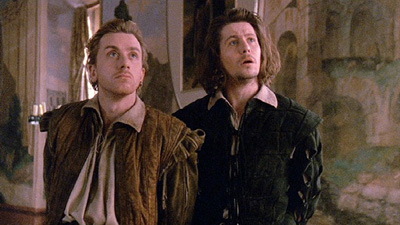
As I mentioned previously, I just wrapped up a production of Tom Stoppard's play Rosencrantz and Guildenstern are Dead. The play tells the story of William Shakespeare's classic tragedy Hamlet from the point of view of two minor characters, Rozencrantz and Guildenstern, who are Hamlet's close friends. Throughout the show, the two attempt to understand why they have been summoned to Elsinore, and ask questions about life, death, and Fate.

Tim Roth and Gary Oldman as the title characters in Rosencrantz and Guildenstern are Dead (1990)
And, this week, in one of my English classes, we have begun discussing Virginia Woolf's final novel, Between the Acts (hence the title of the post). And I cannot help but feel like there is a certain poetry to these two events coming so close to each other. Rosencrantz and Guildenstern is an actor-driven play - the two leads are on stage for the entirety of the show (with the exception of intermission - otherwise, I think my costar and I would have pulled a Hamlet and gone insane!), and never stop talking. But each audience member gets something different out of the show. Because the show is heavily existentialist (the characters always lose track of how they came in, and so they cannot go off, for example), people who connect to that philosophical school are bound to pull different ideas from it than people who are unfamiliar with the thoughts of Sartre and Camus. Audience members who are unfamiliar with Hamlet likewise discover different things in the text. For me, having lived in Rosencrantz's shoes for almost three months, I think that what I found in the play was the idea that even the most innocent-seeming men and women can have the deepest thoughts. It is Rosencrantz who delivers one of the most powerful speeches (in my opinion) - on the nature of death. But he cannot hold onto the idea - he laughs it off, and then becomes infuriated by the events surrounding him.


This idea of audience interaction is one of the major themes that we are discussing as a class with Between the Acts. One of the actors who worked with me on Rosencrantz and Guildenstern is in the class with me, and we are both excited to see where Woolf takes this idea in the novel. I greatly believe in the idea that each audience member takes their own interpretation as they leave (its the same thing that happens with books or movies), and I can't wait to see what happens for the characters in Between the Acts!

Sunday, November 16, 2014

Finding the Right Sources

Finding sources for Mary Surratt has been easy. Finding time to read through them this week, not so much.

This week has been one of the most stressful of my life. I have been working on the fall play (I was cast as Rosencrantz in the school production of Rosencrantz and Guildenstern are Dead), and the show has taken over my life. Finding time to sit down and read through my sources for this paper (or any of the papers that I'm supposed to be writing right now - I have five on the docket) has been nigh on impossible.

That being said, I have flipped through all my sources at least once, so I have a vague idea of what sources will be useful to me.

My idea of what I want to write on, at the moment, is this: Mary Surratt was innocent of plotting to kill Abraham Lincoln. While she might have known about the prior plot to kidnap the president and hold him for ransom, that has no bearing on what she was tried for. Therefore, I only wish to examine her innocence for the charges placed against her: conspiring to assassinate the President of the United States.

As far as primary documents go, the trial transcripts are my best source of information. However, all of the documents are kept on microfiche at the National Archives and are very difficult to obtain. Therefore, I am mostly able to find them through secondary sources, such as Theodore Roscoe's The Web of Conspiracy, which devotes multiple pages solely to reprinting the testimony of Surratt and other witnesses. The other primary sources that I think might be helpful are newspapers. James L. Swanson and Daniel R. Weinberg's Lincoln's Assassins is complete with full-color photographs of many of the primary documents of the time period, which I would not have been able to obtain otherwise.

As for secondary documents, the two that I think will end up being the most helpful to me are the two biographies of Surratt: Elizabeth Steger Trindall's Mary Surratt: An American Tragedy, and Kate Clifford Larson's The Assassin's Accomplice: Mary Surratt and the Plot to Kill Abraham Lincoln. Trindall argues for Surratt's innocence, while Larson argues for her guilt, so it will be interesting to see both sides of the argument. I also look forward to reading through Louis Weichmann's book on the trial and conspiracy, A True History of the Assassination of Abraham Lincoln and of the Conspiracy of 1865. Because Weichmann was the leading witness against Surratt at her trial, it will be valuable to see his testimony as he has written it.

As I have suspected from day one, James L. Swanson's Manhunt has been an invaluable resource to me, providing me with one of the most well-organized bibliographies I have ever seen and helping me to organize my timeline of the assassination, arrests, and trial. I owe Swanson a great debt - not only for sparking my original interest in the assassination, but providing such a well-structured understanding of it as well.

I look forward to being able to interact more with my sources this week and next. The play is finally wrapping tomorrow night (I'm both sad and happy about this - as I am about most things coming to an end), but the good thing is that I will finally have time to get some hardcore research done!

Thursday, November 6, 2014

Coming to a Point: Figuring Out a Thesis

There are multiple ways to formulate a thesis, and every writer has his or her personal favorite method. In the past, I've used two different methods to come to a specific idea.

When I write papers, I typically sit down and begin typing. I don't sit down and think out what I want to say beforehand in an outline - I simply begin formatting my argument, and edit as I go, and after I finish. Before I begin writing my paper, I take a good look at the question being asked, and think about how I want to approach it. For example, I might be writing about women's roles in Virginia Woolf's To the Lighthouse as compared to those in E.M. Forster's Howards End. I would then, after some contemplation on which characters I might want to focus on (in this example, I would automatically pull out Margaret and Helen Schlegel and Mrs. Wilcox from Howards End and Lily Briscoe, Mrs. Ramsay, and Minta Rawley from To the Lighthouse as characters to spend time writing on), and then begin writing. I typically write a working thesis for these papers, changing it as my argument changes. Most of the time, I might begin with a thesis that says something like, "While Forster appears to show that women's role is in the house as part of a marital partnership, Woolf's novel gives the appearance of women having a greater freedom in their choices." However, as I write, my thoughts might change, and by the end of my edits, my final thesis might say, "Although both Forster and Woolf portray marriages in their novels as womanly roles, Forster portrays it as a woman's only option due to societal influences, while Woolf portrays it as a conscious choice made by some women, and not an act forced upon them." The benefit of writing a paper with a fluid thesis is that, while I may have a general idea of what I want to talk about in my paper (in this example, I want to focus on the role of marriage in women's lives in the two novels), I might not have completely fleshed this idea out yet in my head. Writing everything out and then going back to fix my thesis allows me to write down the general idea of what I want to say first, and then go back and make it more specific later.

I would also like to add that I typically only do this with English papers, where I am working with novels whose general plots I am familiar with. I write history papers in a much different manner.

For a history term paper, such as the one I completed last semester for my class on Absolutism and Enlightenment, I began in a different manner. First, I wrote my topic down on a sticky note and stuck it on the wall in a place where I could see it as I wrote and did other class work. As I had ideas, I would add other sticky notes to the wall. Eventually, I focused on one topic that I found most interesting: the role of the maĆ®tresse-en-titre at the Versailles of Louis XIV. That led me to my research, where I began with general information about the court life of Versailles, and then more detailed research on the three main mistresses of Louis XIV. This in turn helped me to solidify my thesis: the maĆ®tresse-en-titre were able to influence aspects of life at Versailles by rising above etiquette. I was then able to format an outline and argument for the paper, focusing specifically on Madame de Montespan, Louis XIV's main mistress, and her role as the life of the court party, in contrast with his morganatic wife, Madame de Maintenon, whose religious faith put a damper on court life. Here, setting a thesis only works after research is completed, in order to not bias the information gathered. A fluid thesis, like the method I use for my English papers, doesn't really work here, mainly because once I know what I want to say, it can't change much, in case I go against my evidence. Rewording the thesis will always happen in the editing process - choosing better words is always a plus - but completely reformatting the thesis because I began arguing something else is probably a bad idea.

Overall, the main difference between my two thesis methods is the amount of research I do. For history papers: research, research, research. For English: pour my brain onto the page, and then edit, edit, edit.

Sunday, November 2, 2014

The Conspirator: Hollywood's Take on the Mary Surratt Trial

This weekend, I watched The Conspirator again for the first time since I began working on my research for my paper. Because it is a Hollywood film, I did take everything it said with a grain of salt, but - that being said - I still managed to find some interesting details that might help me in researching and writing my essay.

Most of these were names. I discovered the names of Mary's lawyers, Frederick Aiken (her defense attorney) and Reverdy Johnson (the man in charge of her case). Johnson was actually a senator from Maryland, and, according to the film (something that I might have to look up to verify) refused to be her defense attorney because he believed that his being a "Southerner" would harm her verdict.

Frederick Aiken (James McAvoy) and Sen. Reverdy Johnson (Tom Wilkinson)
Other names that I found helpful were Louis Payne, Lewis Weichmann, and John and Anna Surratt. Payne's last name was actually an alias - his real name, Powell, was unknown during the trials. His actions form one of the most damning pieces of evidence against Mary. He appeared at her home during the middle of the night, claiming to have been asked to dig a ditch for Mrs. Surratt. She claimed not to know him. Lewis Weichmann provided the main testimony against Mary at her trial, accusing her of being the mother of the plot. His book on the assassination and trial is already on my list of sources, and one that our library conveniently had a copy of. Finally, John and Anna Surratt were Mary's two children. John was definitely close to John Wilkes Booth - during the movie, Aiken calls him "Booth's right hand." Not long before the assassination, John left for Canada, leaving his mother to be snapped up by the government. His sister Anna was placed under protective custody by the government (at least, that's what it seemed like - it might have been house arrest, but the film was rather vague on this point). She gave evidence at the trial, and, from the movie's perspective, was madly infatuated with John Wilkes Booth. The research on these names should hopefully provide me with more information about what happened at the trial.

The film opened my eyes to a number of possibilities to narrow my focus even further - the deplorable conditions, for example, or the trial by military tribunal instead of civilian court. I think what this film has shown me, however, is the qualifications around Mary Surratt's guilt and innocence. While I believe she is innocent, so many others believe she is not. The testimony (at least from the film's perspective) seemed skewed in the government's favor, and the trial seemed to be a sham in order to find someone in the weeks after Lincoln's death to blame. 

I really enjoyed re-watching The Conspirator - it has definitely given me something to think about. 

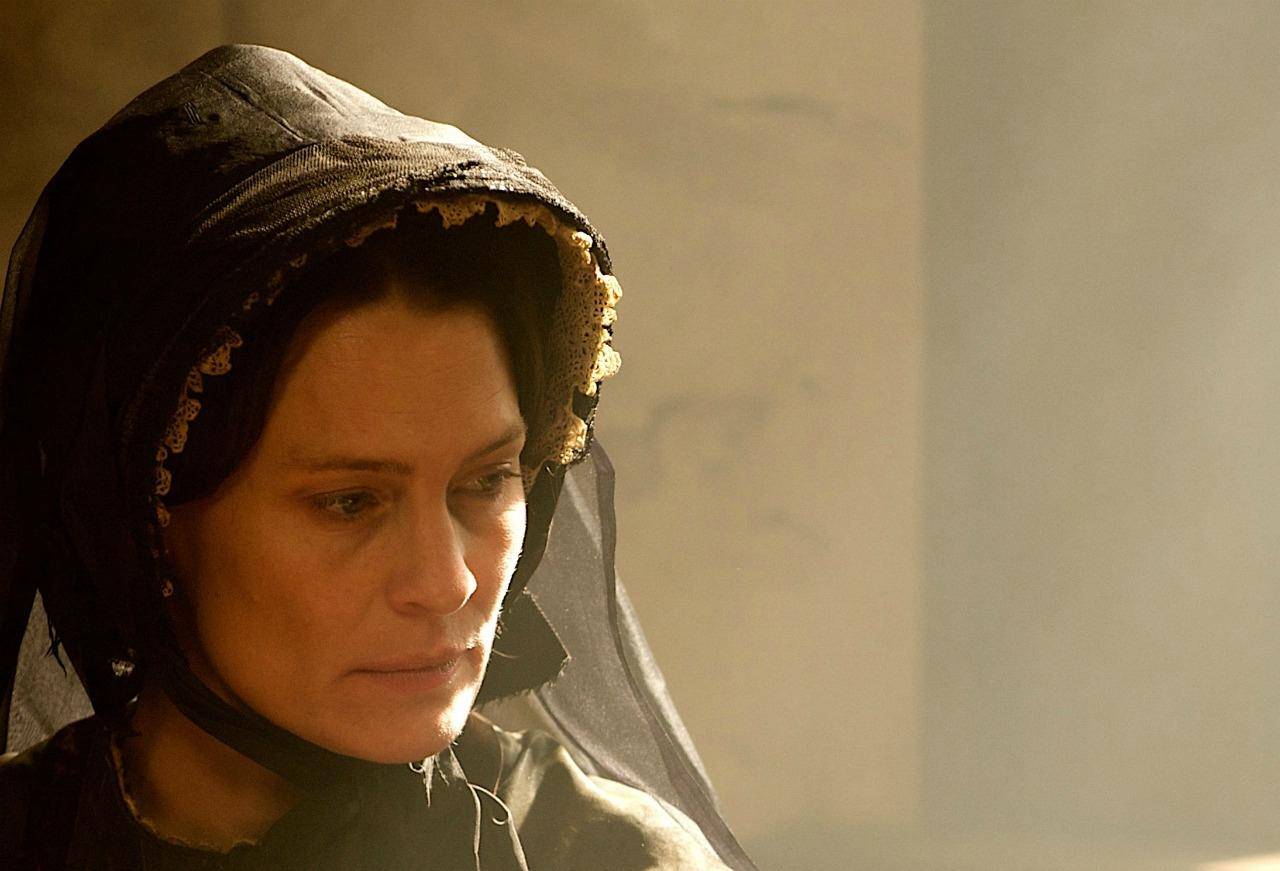
Robin Wright as Mary Surratt in The Conspirator
The Conspirator is available for purchase on DVD and Blu-Ray Disc. It is also available to play and rent on Netflix and Amazon Prime as of this posting. 

Wednesday, October 29, 2014

The Problem of Plagiarism

Plagiarism is bad.

That seems like a really obvious thing to say, but it is.

Plagiarism still happens.

That is a really sad thing to write, but it's still true.

Plagiarism is something that plays a large part in my life. As a History and English double major, I have to be even more careful than the average student in making sure that everything I write has been checked, double checked, and often triple checked for citation accuracy. Fear of plagiarism can keep me up at night sometimes, especially when I have multiple papers going at the same time.

Plagiarism is, according to the Merriam-Webster dictionary, "the act of using another person's words or ideas without giving credit to that person." This may seem easy to avoid, and, most of the time, it is.

Just last week, I received a lecture about plagiarism in one of my classes. My French Revolution professor handed out a sheet on plagiarism, informing us about her past experiences with plagiarism in papers as a professor. In order to prevent them from happening again, she hands out information on it and discusses it for a lengthy amount of time in class. We have to sign a sheet testifying that we have learned what plagiarism is and hand it in the day of the lecture. When we turn in our final drafts, we have to turn in an additional sheet, with our signatures, our paper titles, and the date, acknowledging, once again, that we understand that, if we have plagiarized any of the papers, at least we know what we have done.

We don't take plagiarism as a joke. (I would like to point out here that my professor did mention - in jest, mind you - that we sign our contracts in blood, and then followed up the plagiarism discussion with a documentary on the history of the guillotine. It is a class on the French Revolution, after all).

It can be easily avoided, though.

A handy rule of thumb which has saved me many times: when in doubt, cite it. Better to over cite, and cite something that didn't need citations, than to not cite it, and be pulled before a board or lose your place at the school for plagiarism.

Most things that are common knowledge do not need to be cited. That typically applies to names, dates, locations - that sort of thing. But if you only find it in one source, or if you're paraphrasing or taking a direct quote from an author, then it definitely has to be cited. This is the Purdue OWL's guide to avoiding plagiarism, which most likely explains the rules better than I ever could.

Sunday, October 26, 2014

The Conspirator: Hollywood's Take on the Mary Surratt Trial


As I was doing research this weekend, I discovered (or, I should say, rediscovered) this movie. It's called The Conspirator, and came out just before Lincoln did. It covers the trial of Mary Surratt, from the point of view of her lawyer, Frederick Aiken. I haven't seen this since it was released, but from what I remember, it was a really well done film. I plan to watch it again at some point, either during my research or after this semester, to see how much of the trial they actually got right. The video above is for the trailer. You can watch the film through Netflix, Amazon Prime, or on DVD.