Pages

Sunday, November 29, 2015

Thinking Over Paris

On November 13, Paris was attacked by terrorists.

When it happened, I was out of Bologna, on the Iberian Peninsula. And I had two friends (and classmates) in the city.

So my reactions to what happened might be a little different than anyone else's.

But this is what I've been feeling for the past few weeks.


On my flight out to Spain, I felt like something was wrong. There was a knot in my stomach for the entire flight, and it didn't untwist until we were in our hotel and had eaten dinner. And then we got back, and everything came crashing back.

After we got up the next morning, everything seemed different. I had a wonderful time, but underneath all of it was a lingering sense of dread and fear - of wondering how long the buildings and historic sites I was seeing, the restaurants and cafes that my roommate and I were walking into, would last after we went to them - if, when I turned the corner, that corner would be the last thing I saw.

Getting on the airplane to Bologna, I had my bags searched because I had purchased soap and they thought it could be explosives.

In Bologna, I found out that they cancelled our school trip to Paris - at the time, I figured, because of all of the raids occurring and the issues of having students there when there could still be a viable attack.

Walking to classes in the town center that Monday was a nightmare. For the first time on the whole trip, I didn't feel like being an American gave me any protection at all. If anything, it put a giant red target on my back. And it made me nervous.

All I wanted to do was forget that anything had happened in Paris. My friends made it back safe, and so I wanted to ignore the fact that they had nearly died (and that Europe was beginning to embroil itself in what appears to be the beginnings of WWIII). But my professors insisted on discussing everything - the background of Islamic radicalism, the reasons for the bombings, and what Europe would do next. My friends were allowed to leave the room. I was not.

Tuesday, we had a group meeting that was supposed to be about why we had cancelled the Paris trip. What it turned into was a "let's share our feelings" meeting - which I'm not opposed to, but I had not signed up for a feelings session. I was there for strictly business. I wanted to get in and get out.

And then, our director informed us that he had cancelled the trip, not because he thought it wasn't safe to go to Paris (in fact, he encouraged us to still go if we wanted so that we wouldn't have to lose the tickets we had all bought), but because he didn't want to deal with getting all of us through the increased security in places like the Louvre (which already has some of the tightest security in the world for a museum, so that would've been a hassle anyway). And I was slightly upset - because of all the reasons to not go to Paris, that seemed like a horrible one.

And after Wednesday, it was like nothing had ever happened in Paris. Europeans haven't really done anything different - in fact, Italy said they would be stepping up their security measures, but I've been through the airport twice since they've said so, and I have yet to see it happen.

Yes, the events in Paris are and were terribly sad. And yes, I probably could've gone this weekend and been perfectly safe there (and probably safer than anywhere else in Europe).

But I chose not to.

Because I feel like Paris (and France together) are still in mourning. And I'm not sure that I would have enjoyed a visit to Paris right now, two weeks after the tragedy. Yes, I had classmates who went this weekend and had a wonderful time. But Paris is my dream - ever since I realized that I wanted to study French Rev, I've wanted to go there. And I want to enjoy my dream.

This just wasn't the time to do it.

If I've learned anything from my studies, though, it's that the French are the wrong people to mess with. Attack them - take away their rights, their bread, their land; destroy their cities, kill their people,  occupy their towns - and they unify and attack right back.

France will come out of this more unified than we have seen them in a long time.

I send prayers towards Paris, and the people who live in France. May your nation find peace again.

"Français, en guerriers magnanimes
Portez ou retenez vos coups!
Épargnez ces tristes victimes,
À regret s'armant contre nous."

 - La Marseillaise, French national anthem dating to the French Revolution

Wednesday, November 18, 2015

Searching for the Infinite

This past week was insane! Not only did I have my first art history test of the year (never have I been so grateful for AP Euro before in my life), but I had a major Italian test. I was ready to leave for my weekend trip on Friday when the time came.

First, however, I had Cultural Friday. This week, we discussed the Bologna Bombings in the 1980s, and their effects on the city. A suitcase was left in the second-class waiting room in Bologna Centrale, the train station in the center of the city, and exploded at 10:25, taking out the second and first class waiting rooms, the bar next door, and the postal offices above. It also destroyed the first platform, and blew debris outward, killing two taxi drivers and causing the area to cave in on itself. 85 people died, and 200 were wounded. The people of Bologna rallied to help, using taxis, buses, and other private vehicles to carry the wounded and dead to the hospital. The most famous of these buses is Bus 37, now a symbol of the events, along with the clock at the station, which was stopped when the explosion went off at 10:25. The case has never been solved, and, although suspicion lies on the right-wing parties and on the government (since Bologna is a traditionally left-wing city), no one has concrete evidence to suggest either party is guilty. 

The clock at Bologna Centrale
We visited the train station, looking at the memorial and viewing the names of those who had died. However, when we visited, we were told that the visiting professor had to speak quietly because we were discussing a terrorist attack and it was a high alert day. We went through the discussion as quickly as possible, and then the class left the station to meet an eyewitness while I met my roommate to go to the airport for our flight to Barcelona.

We flew out to Barcelona with no issues - nothing was happening, except for student protests in Rome and Naples. When we arrived in Barcelona, we were both surprised by how modern the airport was, in comparison to others in Europe (especially Bologna's). After waiting for almost an hour for the train, we managed to make it into the city center, using the metro to get into Barcelona proper. A five minute walk from Las Ramblas led us to our hotel, Hostal El-Jardi. It sits above Hemingway's favorite bar in the area, Bar del Pi (which I didn't know when we booked it, but made me very excited).

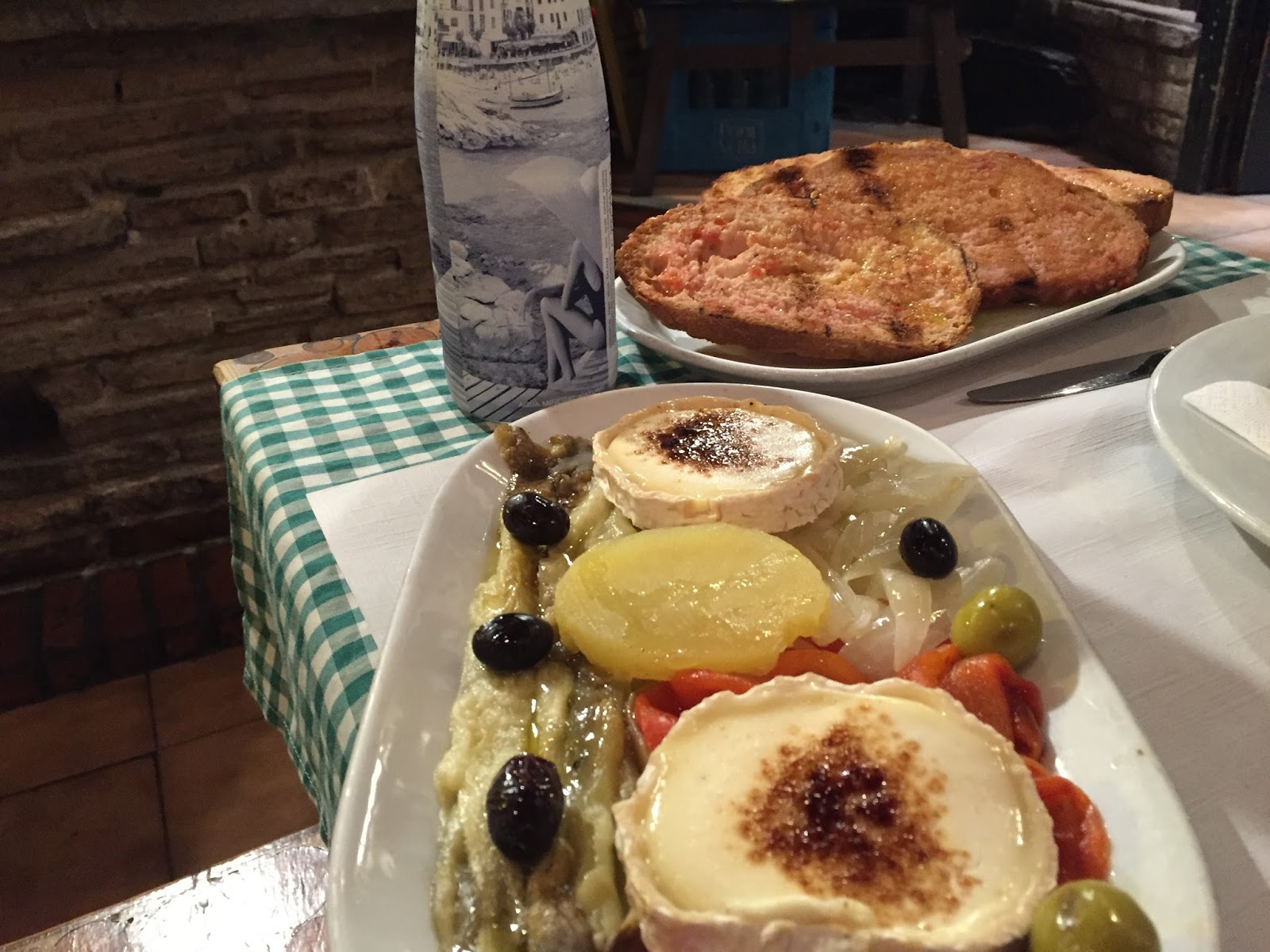
After a quick rest to recuperate from the plane and train, we wandered around the area near our hotel, popping into shops and buying gifts for friends and family. Around 8:30, we walked to our restaurant for the evening, which served traditional Catalan food and had been recommended by our concierge. Thanks to the card from the front desk, we were given free cava, a local sparkling wine, to go with our meal. After consulting with our waiter (who was from Sicily, and quite excited to talk about Italy with people), we chose an appetizer of grilled vegetables and goat cheese, and separate entrees. 

I kid you not when I say that we both agreed it was the best meal of the entire trip. 

Grilled vegetables, goat cheese, Catalan bread, and water
I have never once in my life tasted eggplant that has been grilled like that - so soft that it melts in your mouth. And the goat cheese was excellent. It was served with grilled onions, potatoes, and red peppers, and pieces of Catalan bread rubbed with garlic and tomato - perfect for putting everything together into one bite. Then came our entrees - and, let me tell you, I have never eaten such delicious sausage and white beans before in my life. I don't know how they did it, but I would happily eat that meal for the rest of my life. 

The most delicious sausage and white beans ever created (sorry, Dad)
We finished up with a Catalan pudding, and paid our bill (incredibly low, for the quality of food). We walked to the Starbucks we had seen on the way there, buying some coffee, and went back to our room. 

It was there that we found out about Paris. 

We had classmates in Paris - in fact, the first thing we heard about what was happening was a classmate asking on our GroupMe if we had heard from them. Once we had talked to them, my roommate rolled over and went to sleep. But I stayed up for another hour, fielding worried texts from my mother and messages from friends back home, checking to make sure I wasn't in Paris, too. 

I finally got to sleep that night, wondering if I would be able to sleep soundly at all.

Apparently, I did, because when my alarm went off early the next morning, I groaned and rolled over. My roommate and I grabbed a quick breakfast at our hotel, and then took the metro to visit the Basilica de la Sagrada Familia. Begun by Antoni Gaudi in 1882, the church was still incomplete at the time of his death in 1926. Today, the church is still being worked on; according to videos on the basilica's website, they hope to have it completed by 2026, the 100th anniversary of Gaudi's death. 

Sagrada Familia, Nativity Facade 
Sagrada Familia from the plaza across the street
The church overwhelms the tiny plaza that it sits on - completely dwarfs it, in fact. My roommate and I walked all the way around both the plaza and the church, taking it all in, and still could not grasp how large it is. Walking inside, it's even more awe-inspiring. Gaudi took many of his inspirations from nature, and so the columns look like trees in a forest; the spiral stairs, like nautilus shells; and the roof is decorated with fruit. Everything is built on a grandiose scale, and yet still feels very intimate.

Passion Facade, Sagrada Familia
Columns of the church 
Interior panorama, Sagrada Familia
At the back of the church is a door with the Our Father in Catalan. Behind it is the same prayer, but in the languages of Europe, Africa, the Bible, and America. And this reminded me that, while the church might be dedicated to the Holy Family, it is also a church of unity - something that seemed even more important in the face of the attacks in Paris the day before. My roommate and I took a moment to pray among the stained glass and the high ceilings. And I don't know what my roommate was praying for, but I was asking for my friends to get home safely, and for Paris to unite together, and for everyone to be able to forgive what had happened, and for us to be able to come back to Bologna with no incident. 

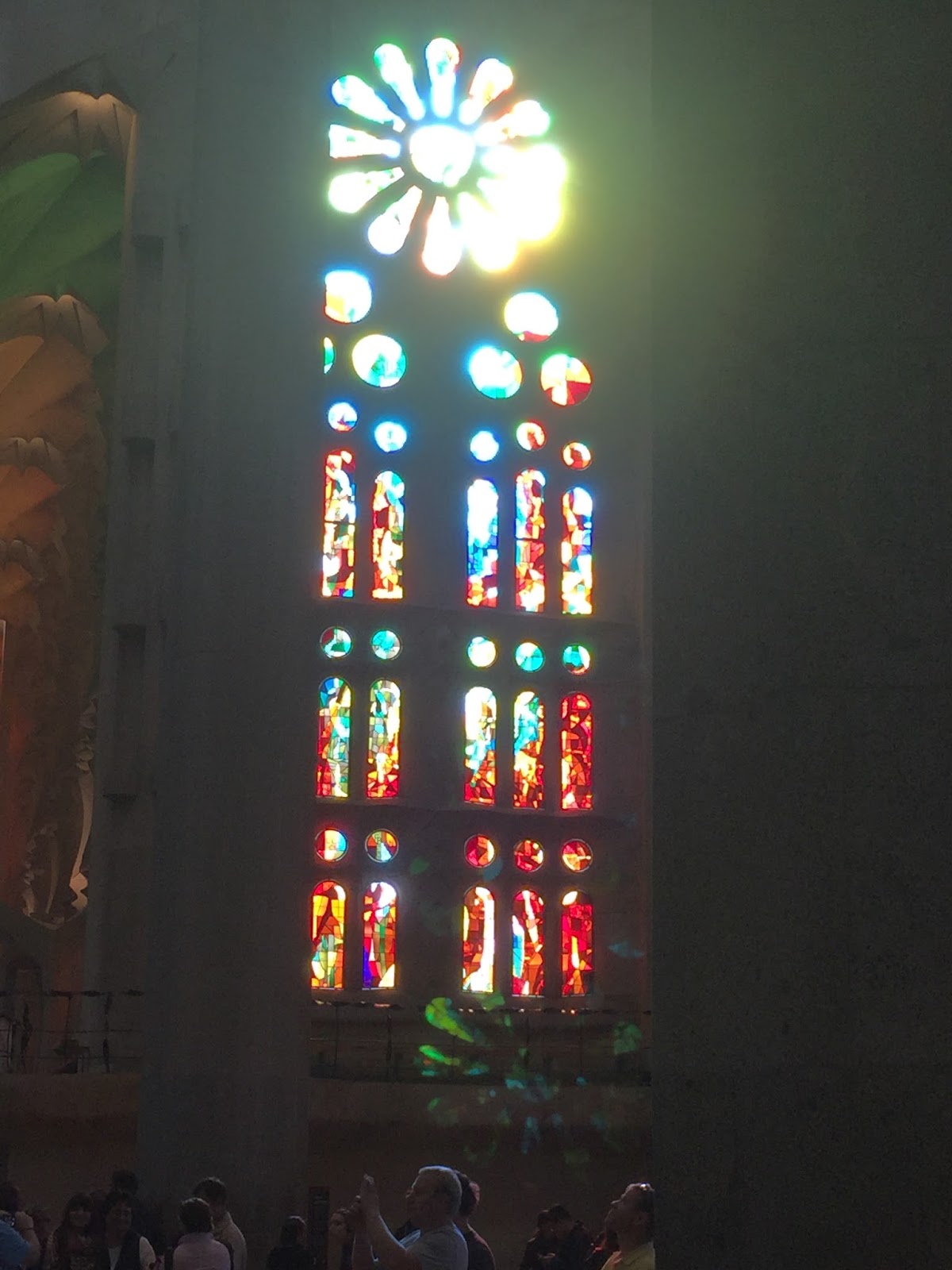
The stained glass window
And I didn't ask for any sign that my prayer was heard, but as we were leaving, the stained glass window next to the door with the Passion on it lit up in a glorious display of light. And I couldn't not take that was a way of God telling me that he had heard my prayers.

The front facade - the one that we had entered through - is decorated with the Nativity story. The one that we exited through is called the Passion facade, because the doors are covered in the story of the Passion, and the statues show the Passion and death of Christ.

After we took a last look at the church, we grabbed a quick coffee, figured out where our next stop was, and checked in with our friends in Paris. Then we got back on the metro, and went back a few stops, traveling towards La Pedreda - what we in English (and Spanish) call Casa Mila. 

Unfortunately, we managed to come up on the wrong part of the street, and so we had to stop into a book shop and ask for directions. It turned out that, while we had stopped at the right metro, we had walked the wrong way after getting off. We speed walked to the building, down the Passseig de Gracia, and made it to La Pedrera panting. The guides laughed at us, and motioned us to the right entrance, where we were given free audioguides and sent on our merry way.

Casa Mila, also known as La Pedrera
The tour starts on the roof, where Gaudi used his architectural prowess to design the most beautiful chimneys, forming twisting sculptures out of clay and mosaics. Two actually form frames around churches in the distance: a church in the mountains, and Gaudi's own Sagrada Familia. From there, we descended into the attic, where we got to see the skeletal nature of Gaudi's design to keep the building warm in the winter. We also visited some of the apartments, where families lived in rooms lit naturally by the sun, no matter where in the building they were. The building, we were informed, is still used, and men and women live in it today. 

One of the chimneys 
Roof panorama, Casa Mila

One of the "frames," with Sagrada Familia in the distance 
The ceiling structure that makes the roof possible 
A reconstructed bedroom in Casa Mila's apartments
The view up from the courtyard where original residents would drive their cars in
From La Pedrera, we walked to lunch (where we had paella - something I can finally check off the bucket list), and then wandered down Passeig de Gracia for the afternoon, popping in and out of shops and drinking coffee. We walked back to the bookshop that we had visited earlier, and, in the midst of searching for a copy of Hemingway's The Sun Also Rises (what better book to buy in Spain than Hemingway's ode to Spain?), I saw a copy of A Place of Greater Safety sitting on the shelf in front of me. I tried to walk past it (in fact, I walked all around the English language section trying to pretend it wasn't there), but the image of the tricolore on its cover kept coming back to haunt me. Eventually, I caved and bought it. Sometimes, there are feelings that are just too significant to ignore - and seeing a tricolore on this day was one of them.

We took the metro back to our hotel, where we did some more shopping and then stopped for dinner at a tapas bar recommended by our hotel. Again, we had free cava; this time, we followed the tasting menu recommended. The food was lackluster in comparison to the night before, and we both agreed that we needed to go back to the first restaurant the next evening. We walked back to the hotel and got ready for bed, ready for what the morning would bring.

Cava and tapas
Sunday morning dawned bright and early. I woke up, and my roommate and I walked to the Cathedral of Barcelona, five minutes from our hotel. I went in for Mass while she chose to wander around the city. When I got out, we went to Starbucks so that I could get breakfast and we could decide what to do. 

Cathedral of Barcelona
I wanted to find a copy of Sun Also Rises still, so we went up to the north of town to find the English language bookstore. Unfortunately, Google had lied to us, and it was closed. We wound up wandering the area for a little bit, and then took the Metro to Passeig de Gracia, hoping to find another one that might be open. 

It turns out Barcelona keeps everything closed on Sunday mornings. Except Starbucks.

So we took the Metro down to the beach, and my roommate and I laid on the sand for an hour and a half. It was long enough (and hot enough) that, despite my long sleeves and leggings, I have a sunburn.

Absolutely gorgeous day at Playa de la Barceloneta
Nothing like a little light beach reading
When we were ready to go, we walked to a small burger shack near the water (but far enough off it that the prices were still reasonable) and got some lunch. I had an amazing avocado smoothie (not something I ever thought I would say) and a chicken sandwich with pineapple. We walked from there to the Museu Picasso, which is free after 3 PM on Sundays, and waited in line to get in. Once inside, we polished off the one floor of artwork quickly - although my roommate's face when she realized that Picasso was modern art was rather priceless.

After touring the museum, we walked back to our hotel, and rested for a little while, before walking back to the restaurant from the first night. We ordered a completely different menu - chickpeas with ham for the appetizer, and grilled rabbit for the main course - but still had free cava. While the food was still good, we agreed that the meal from the first night was better, and both wished we'd ordered the same food again. However, I enjoyed the dessert I ordered much more the second time - chocolate cake - than I did the custard, and the cafe con leche I had was excellent. 

We packed up that evening, and, as we headed home the next day, I wondered about how my thoughts on Barcelona had changed.

Originally, I had wanted to go anywhere but Barcelona. In Spain, I wanted to go to Madrid, Toledo, or Seville - places that had always fascinated me as a student in Spanish class, places with strong cultural heritage and lots of museums. Instead, we went to Barcelona, a part of the country that doesn't primarily speak Spanish (the main language is Catalan), and whose main draw for tourists is football, followed closely by beaches and Gaudi. Never in a million years would I have thought that Barcelona changed me.

There was a video playing in Sagrada Familia that talked about Gaudi and his plans for the church, and in the video he talked about how he believed the church was a physical representation of man's search for the infinite. Barcelona has definitely shown me that I'm still on that search - searching for the things more powerful, greater, and longer lasting than I am. I think I saw it in Sagrada Familia - maybe I caught a glimpse of it too in that bookshop. But I'm going to keep looking for it everywhere, no matter where I am.


Muchas gracias, Barcelona, por ayudarme buscando il infinito.

City of Light and Water: Returning to Venice

After a second week of extreme testing and stress, nothing was more exciting to me than the prospect of visiting Venice again with my mother and grandfather. They had come into town on Thursday to visit Bologna, and so I was able to take them around town and show them my favorite spots (my gelatoria, my coffee shop, and my bookstore, among others). Friday morning, after Cultural Friday, we stopped for lunch at a Neapolitan pizza restaurant, Spaccanapoli, and grabbed some gelato before heading to the Bologna train station.

Venice, as expected, was gorgeous. Unexpectedly, it was not under high water, or acqua alta. We were able to move for most of the trip unencumbered.

We visited most of the same places that I had visited with my roommate a month before (in fact, thinking about it now, I believe we did the exact same trip), but this time I got to sit back and reflect on what I really love about Venice.

Piazza San Marco from the water
Venice has always had a siren's call to those who read and write, beckoning them with her Italian heritage mixed with her Islamic influences. Her architecture, her mysterious, sinuous canals, all lead to a sense of wonder and awe - a surprise that never quite disappears. You never know what will be around each corner, whether you're walking on land or traveling by vaporetto or gondola. And part of this is because Venice is still so in touch with its past.

The Bridge of Sighs from the water
One guidebook that I read (so many years ago that I'm not sure I still remember who wrote it) said that Venice is a sinking museum. And I think I might have to disagree with that now. Certainly, Venice is sinking. It's hard to ignore that when every floor you walk across is uneven and the cobblestones are popping out of the ground, when there are waves lapping up against everything and the evidence of the gentle persistence of water is everywhere. But I don't think the Venetians have abandoned their city to be simply a soulless place, with only empty buildings preserving the past. There's a liveliness to Venice that is unlike anywhere else in Italy - a life that has been built over generations, designed by people who were persistent enough to keep building on top of islands washed away slowly by water and time, who understood that what they created might not last for all time - but, no matter what, they would try their darnedest to build something that would survive them.


I may feel most at home in towns like Florence and Bologna, but there is something about Venice that will always call me back. It's as if I have unfinished business there.


Getting Back My Soul: Voyaging to Parma and Florence

This week has been spectacular, but also incredibly stressful.

It started out like any other - school and classes every day - but, on Wednesday, I had the first of three tests for my Italian 101 final. If I didn't pass it, I would not make it into my Italian 102 class (in case you were wondering, I did, in fact, make it - I got the news today). I had a presentation on my family and hometown, a written exam, and then a final oral presentation on a piece of artwork by Correggio in Parma, the Camera di San Paolo - in front of my Italian professor, my art history professor, my art history class, the Advanced Italian class, and the artwork itself.

It was a little stressful.

Despite my stress, I woke up on Friday morning eager to see what Parma had to offer. We took an early train with our whole class to the city, which stopped along the way at several cities (including Modena, home of balsamic vinegar). Once we arrived at the station, our art history professor turned to us all and said that we would start the morning the Italian way - with coffee and a brioche - before we began presenting.

I'm pretty sure we all cheered.

We walked into a small cafe and ordered, sitting down and relaxing momentarily before we began the morning. Then, leaving the cafe, we walked to the Camera di San Paolo, but not before stopping before the former palazzo of the Farnese and learning a little more about the history of Parma.

Parma has always been an important city because it falls in an area making it ideal as a capital. During the time of Paul III (who commissioned The Last Judgement from Michelangelo), the city was taken from its independent spot in Italian politics and brought into the Papal states. Paul III granted the area to his family, the Farnese, who promptly began to build a palace in the city. It was never completed - mainly because the male line died out and the family was replaced with the nearest male heir, Charles Bourbon, the King of Naples (and a Frenchman). Napoleon later plundered through the area, actually planning on taking the Camera di San Paolo with him to a prepared room in Paris, but before he could remove it, he fell from power.

So, with that in mind, we went to go see Correggio's great work.

The room is part of a series of rooms commissioned by Giovanna da Piacenza, the abbess of the Benedictine order who lived there. The sisters were all noble women, well educated, and acted as such. They weren't forced to live in their habits every day until after the Council of Trent took place, so their appearance was very much that of any noblewoman of the Renaissance. Unlike other noblewomen, however, they were cloistered, meaning that they could never have contact with the outside world. The abbess commissioned a new set of rooms for her use, and the first of these was painted by an artist named Alessandro Araldi, a Renaissance painter heavily influenced by the work he witnessed in Milan and Rome. However, the second commission went to Correggio, who painted a brilliant green ceiling filled with lunettes, putti, and mythical allegories.

Camera di San Paolo, Correggio
The room was lost to the art world until its rediscovery in 1774 by Anton Raphael Mengs, a German artist and art historian at the end of the Baroque era (but if he was asked, he would say he was Neoclassical) who studied Correggio's use of chiaroscuro - a technique perfected by Caravaggio that balances light and dark. With Mengs' discovery, the popularity of Correggio soared - in fact, of any artist, it is probably Correggio who had the most influence on the Baroque movement.

The room is inspired by scenes and stories from Greek and Roman mythology. Diana adorns the fireplace, not only because she is a chaste goddess (and chastity is a vow of the Benedictine order), but because she is the goddess of the moon, and crescent moons were in the crest of Giovanna da Piacenza. The putti, or little angelic figures who line the second row of figures, all hold symbols of Diana - hunting dogs, weaponry, even a stag's head (from her interaction with Acteon). The lunettes around the room are more difficult to decipher, but the first two walls (the North wall, with the fireplace, and the East wall) have been decided upon, for the most part, based on the iconography available. The other images are unknown.

Camera di San Paolo, Correggio
After presenting on the Camera, we went across the street to the Teatro Farnese, where we listened to the Advanced class present on the history of the theatre. The Teatro was built by the Farnese as a display of their wealth and power, and was the site of horse parades and mock naval battles. It is also built on a sloping stage model, so the further up the stage we walked, the more angled the boards were - allowing for the audience to see every action on the stage. It was the first time that I had been on a stage built that way, and so I was incredibly excited to see what it was like.

Center stage, Teatro Farnese
From the Teatro Farnese, we left for a quick lunch break, and then headed to the Piazza del Duomo, where we met up with our classmates and professors again to discuss more Correggio. We visited first the Church of San Giovanni Evangelista, where Correggio painted a lunette of St. John the Evangelist, the dome of the church, and an image of the coronation of the Virgin (which is now a copy). The dome contains an image of the Ascension of Christ, with all of the Apostles watching in awe. In the bottom, from a certain angle, you can see St. John peeking up - whether we're seeing his vision at Patmos or he is viewing the Ascension, art historians are not sure.

San Giovanni Evangelista
Our next stop was intended to be the Duomo of Parma, but our professor told us that, unfortunately, the Mass schedules had changed, and we would not be able to go in as a group and see the Assumption of the Virgin that Correggio had painted on the dome. We could, however, sneak in and wander towards it, if we wanted. We walked into the church, but Mass was going on - and being said by the Cardinal, no less. Instead of trying to see the dome (which you can't, unless you're right under the altar), I turned around and left. We met up outside of the Church (but not before I picked up a small vial of violet perfume, which Parma is known for). We then headed to our final church, Santa Maria della Steccata.

Piazza del Duomo (l-r: Diocesan building, Cattedrale di Parma, baptistry)
Unfortunately, we managed to all walk in in the middle of Mass at the church. We waited until Mass was over, and then walked to the front, where a painting by Parmigianino - his last - is over the altar. It portrays the story of the wise virgins and the foolish ones. Once we left, we were free to do whatever we wished and catch whatever train we wanted. A couple of my friends and I tried to go back and see the dome in the cathedral again, but there was a group of people doing an evening rosary, so we had to leave again. We grabbed some gelato on the way to the train station, and then they left for Bologna while I waited for a train to Florence.

Santa Maria della Steccata
Once I made it into Florence, I met up with my mother and grandfather, who had come to visit me for the weekend and the one after. We walked back to our hotel (actually a convent) from the station, and then I collapsed in bed.

We woke up early the next morning, for our visit to the Galleria dell'Accademia. The Accademia, among other things, is home to many priceless works of art by Michelangelo, including his most famous: The David. Because we arrived so early, there was no one there, and I was able to take photographs all the way down the gallery with no tour groups in front of me.

David, Michelangelo Buonarroti, Galleria dell'Accademia
The David is really quite striking in person - photographs don't do it justice. There's a pensive anger to his gaze that has always spoken to me. It's as if Michelangelo captured the quite strength of someone who knows exactly what it is that he has to do, and who knows that he is justified in doing it. There is a regality to this David that is not in any of the others of the period, and I think that it comes from Michelangelo's focus on the expression and not on the stance.

David, Michelangelo Buonarroti, Galleria dell'Accademia
Also in the Accademia are Michelangelo's unfinished Slaves for Julius II's tomb, his incomplete St. Matthew for the Duomo of Florence, and an incomplete Pieta that may or may not have been done by Michelangelo. We also had the chance to see the plaster cast for The Rape of the Sabine Women and, in the adjacent Music Museum, a Stradivarius owned by the Medici family. It was a pretty exciting morning.

The Rape of the Sabine Women, Giambologna, Galleria dell'Accademia
After the Accademia, we wandered down towards Piazza della Signorina, and looked for a cafe to kill time until we could enter the Uffizi. After some coffee and a snack, we walked into the doors of the Uffizi and began our tour of Italian Renaissance art. Almost every famous work you can think of is in this museum - Botticelli's Primavera and Birth of Venus, Leonardo's Annunciation, Michelangelo's Doni Tondo, works by Paulo Uccello, Filippo Lippi, and Giotto line the walls. Classical statues fill the hallways. Caravaggios and Titians fill the lower rooms. It's an art lover's paradise.

After the Uffizi, we walked to a small local restaurant that my grandfather had visited on his first visit to Florence with my mother and ate dinner, then walking to Grom, a gelateria near the Duomo, for gelato. We returned to our hotel and crashed into bed.

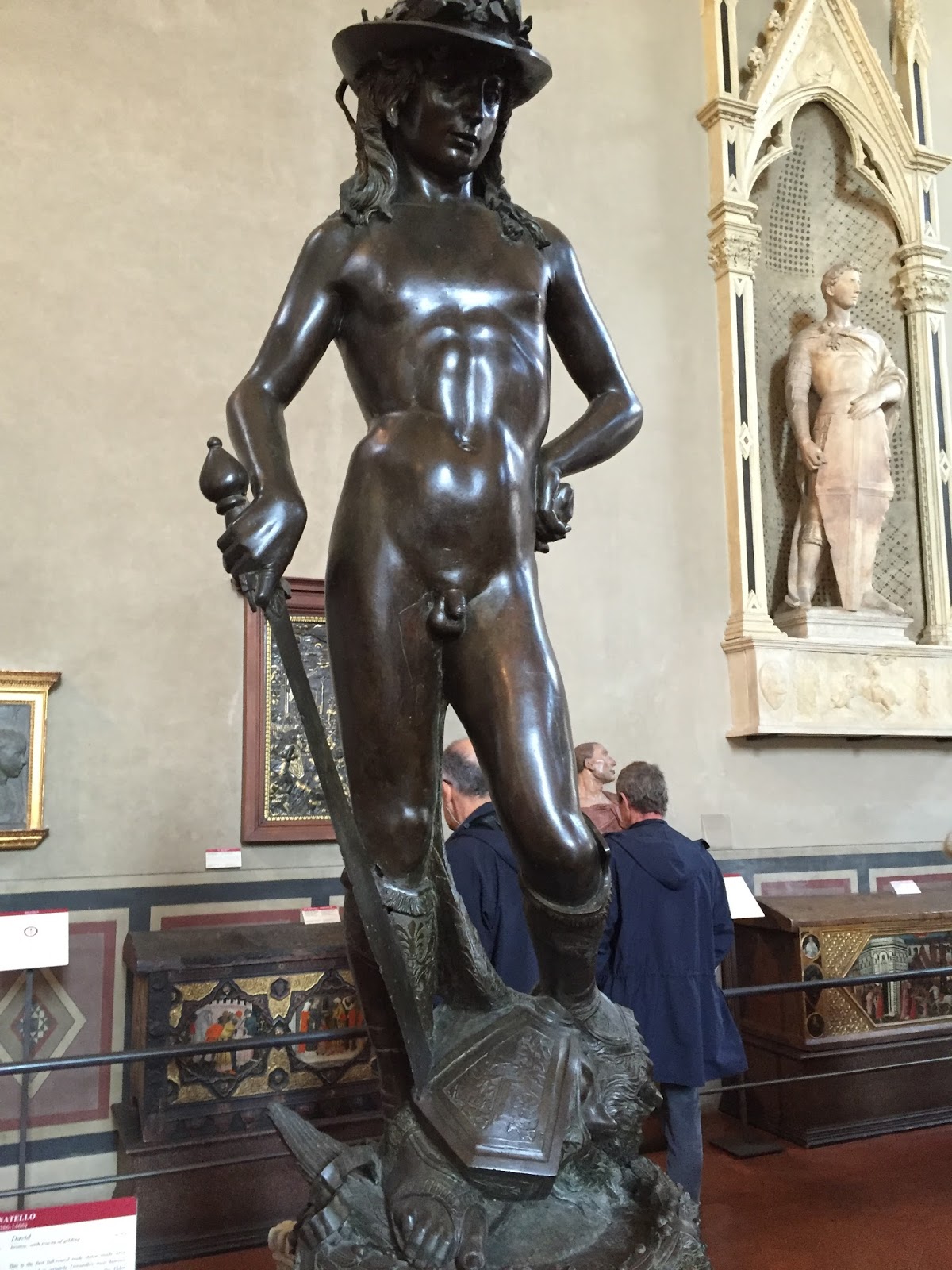
The next morning, we woke up for Mass at the Duomo, and then walked to the Bargello. All museums run by the Italian State are free for the first Sunday of the month, and we took full advantage, visiting two. The Bargello houses Michelangelo's Bacchus along with both of Donatello's Davids and his St. George. Every room is chock full of items that showcase the history of Europe.

David, Donatello, Museo del Bargello
After the Bargello, we made our way across the Arno to the Palazzo Pitti, where the Medici under Cosimo I and, later, Napoleon's sister Pauline Bonaparte and her husband lived. The royal apartments (the real draw) were closed for the day, but we did get the chance to wander through the Palatine gallery, where Raphaels are placed next to Titians, Tintorettos, and Boticellis in one of the most jaw-dropping family art collections in Europe. Apparently, the Medici also collected the portraits of European royalty, because I saw members of almost every single European royal family on the walls of the Palatine gallery, casually looking back at me as if to ask why I was in their presence in a t-shirt and leggings.

After the Palatine, we made our way up to the Boboli Gardens, built on the hills behind the palace. It offers stunning views of both the palace and the city, and also houses a collection of feral cats. We saw one of the cats while we were there, but it just kind of stared at us all, before disappearing into the bushes.

Florence from the Boboli Gardens
After a quick lunch, we made our way to the Brancacci Chapel. Painted by Masolino, Masaccio, and Fra Filippo Lippi, the church was damaged by fire and some of the works within it were lost. The Brancacci Chapel, however, was not. It remains as striking as it was to those who first viewed it - and also less heavily trafficked by tourists, because it is across the Arno in a local church. Its frescos also influenced the work of Michelangelo, who practiced his drawing skills by copying the figures in the Tribute Money.

Tribute Money, Masaccio, Brancacci Chapel
We returned to our hotel, and then ventured out for dinner by the Church of San Lorenzo, at a place that I had visited with my family on our trip to Italy. After an enjoyable dinner, we went back to the hotel, exhausted.

The next day, we walked to Santa Croce, to buy leather goods from the Scuola behind the church. We also walked across the city to Santa Maria Novella to look at their perfume shop. After eating lunch, we stopped back at the hotel, picked up our belongings, and walked to the train station, so I could return to Bologna and my family could head towards Rome.

Most of what I was thinking about while in Florence was the E.M. Forster novel A Room with a View. So many of the places I visited were ones that played crucial roles in the story (Santa Croce - although I didn't have or need a Baedeker; Piazza della Signorina; the Arno; the city itself). There is a quote from the novel that quite summed up how I feel about this trip to Italy, and that I think sums up what I'm hoping for from this journey:

"Italy was offering her the most priceless of all possessions - her own soul."

Thursday, October 29, 2015

Lights, Camera, Milano

Last week was a whirlwind! The week seemed to just drag on forever.

On Wednesday, I became a legally recognized temporary resident of the country, completing the steps of my permesso di soggiorno (finally). I had to report to the immigration office and have my fingerprints taken at 9:00 in the morning with two other classmates whose paperwork had been misplaced the first time. But when we got there, the officer at the front didn't let us in. We had to wait another 30 minutes for our times to be called - long past the times we had scheduled. As I walked past the officer, I saw that my name wasn't actually next to my time - they had scheduled someone else in my slot!

I went up to the window to talk to an officer, and everything was running smoothly - until he couldn't find my packet in the pile. Which, of course, made me panic. Apparently, my packet had been placed in the wrong pile, however, and as he walked back, I collapsed and said a little prayer of thanksgiving. The officer noticed and asked me if I was okay. When I said I'd been worried, he shook his head at me and, waving his hand, said, "Don't be worried." It went pretty smoothly from there.

All three of us were given sheets telling us when to complete our third step, and I was told that I needed to do mine before 12:30 on Wednesday. The other two didn't, so one left to go to Italian class, and the other came with me to find the police station we needed to go to, since her appointment was the next day. When we arrived, I saw a woman who had spoken with us at the immigration office, so I was more comfortable and knew we were definitely in the right place. My classmate left, and I waited in line to be fingerprinted more fully.

This time, the government (instead of taking copies of just my fingerprints) copied my thumbprint, palm print, and full handprint. They also measured my height. Then I was free to go.

Walking back from the center of town, I realized that I had 15 minutes until my Italian class started. So, thanks to the Italian government, I was late to Italian class.

Thursday, my art history class went to visit a church a few minutes walk from Poggeschi that contains a copy of a Raphael painting, The Ecstasy of St. Cecelia. The original, painted in 1514, is kept in the Bologna National Gallery, but at the moment is on display in Torino. For a copy, the painting managed to capture the gracefulness of Raphael's work perfectly. I can't imagine what the original looks like.

On Saturday, I needed a break. So my roommate and I headed off to Milan, a two and a half hour train ride from Bologna. We left early in the morning, taking a 7:00 train and arriving in Milan at 9:50. Once we got to the city, we had to make our way to the very bottom of the station, where we needed to buy tickets to the Metro for the day. Once we had tickets, I had to teach my roommate how to use the Metro, since she had never used one before. We took the Metro to the Duomo stop, and came out into the Piazza del Duomo, the heart of the city.

Piazza del Duomo
Immediately, we were faced with two things: the Duomo and people. The Duomo dominates the piazza, its Gothic facade looking with an imposing glare down its length. Around it were so many people - many more than we've seen anywhere else we've gone this entire semester, even in Venice. Vendors kept coming up to us, hawking selfie sticks (when did this become a thing for street vendors? the only people I've seen with them here are Japanese tourists, not Americans or any Europeans) and trying to grab our wrists and "give" us bracelets. One man actually did this to my roommate, who tried to fight him off, but he grabbed her wrist and tied a bracelet to it anyway. A friend of his came up to me, trying to give me one, too, and grabbing at my wrist, but I crossed my arms and refused. I'm not sure I could have made myself more clear - I only said "No, grazie," to him, and despite him trying to force one onto me - literally trying to tuck it into my hand - and telling me it was his birthday and it was very much for free, I continued to say no and walk away from him (while staying near my roommate, who was fighting her own battle). I even dropped the one he tried to force on me on the ground and he wouldn't stop. If my roommate hadn't finished with her guy any faster, I would have been forced to call the police over.

Il Duomo

The ticket booth had this handy map sketched on it

Once that ordeal was over, the two of us walked into the Duomo, passing by the stage for an outdoor concert being hosted by the MTV European Music Awards. As we entered the church, everything became very quiet - and both of us were awed by the beauty inside.

The Duomo is gorgeous. It's so chockfull of art that I can't even begin to explain it all. My roommate and I just wandered around, trying to analyze the pieces (since we're both in art history) and talking about what everything was used for (since she's not Catholic, and was a little confused). Then, after taking a long last look, we left.

Il Duomo

Il Duomo
And turned into the oldest shopping mall in the world, Galleria Vittorio Emmanuelle II. It's absolutely  awe-inspiring. We wandered into shops that I never in my life would walk into - except, since Milan is the fashion capital of Italy, it made sense for me to walk into Louis Vuitton, Prada, Gucci, and Versace within minutes of each other. I still managed to see things that I was interested in, too, though - we walked into the oldest bookstore in Milan, an art book store, which sadly had a (very) limited English selection, and one of the largest, Liberia Rizzoli, a three floor bookstore with beautiful books and a great selection of bookish accessories (tote bags, notebooks, and pens, among other things).

Galleria Vittorio Emmanuelle II - Prada on the left and Louis Vuitton on the right
We made a stop for lunch outside of the Galleria, at a place called Granaio - which my roommate termed "an Italian Cracker Barrel." The restaurant was decorated with the store's homemade pasta and biscotti, and they specialized in Milanese comfort food. I managed to try both the risotto alla Milanese and the pork ribs with beans, which were delicious. We topped it all off with a pot of tea, which was nice after all the coffee we've been served here.
After lunch, we walked into a chocolate store, where we bought chocolates for ourselves and for friends, and then made our way towards the Pinacoteca Ambrosiana, about ten minutes away. The Pinacoteca houses art by Sandro Botticelli, Leonardo da Vinci, Raphael, and Caravaggio, and when we went to visit, was hosting a special exhibit of Leonardo's Codex Atlanticus, the largest collection of his scientific drawings. The art was beautiful (and they let us in with a student discount!), but I don't think I've ever been so excited to see documents before - especially the picture of Leonardo's first flying machine, which was practically just a boat with wings. That image definitely made my day.

Pinacoteca Ambrosiana
As we wandered back, we stopped in a gelateria and tried chestnut gelato - which was amazing - and popped into a few more shops, before deciding that we needed to make our way back to the Metro and the train station. However, all the stops for Duomo were closed off.

What we didn't know was that, due to the MTV Music Awards, all of the stops for Piazza del Duomo had been closed for the evening, and we would now have to find an alternate route back to the train station. We ran completely around the Piazza, looking for an open station, and when we couldn't find one, we stopped a security guard and asked him where to go. He pointed to a station down the road that was open, and we ran to it.

Once we got on the train, we knew we needed to switch onto the yellow line - and the only way to do that was at Duomo. But we had forgotten that it was closed, so when we passed the Duomo stop, we had to get off and do a complete recalculation. We wound up going down another four stops, switching to the green line, and then taking THAT train back four stops to the stop for the train station. Once we got there, we took off down the platform at a flat-out run, realizing at the last minute that we had twenty minutes to spare. We bought some water, walked onto the train, and collapsed.

But then our train had technical problems, and our conductor told us that it had been cancelled.

We now had two options: wait for the 10:15 train to Bologna, or take the 8:50 to Lecce, which stopped in Bologna and was completely sold out - which meant we would have to stand in the hallway for two and a half hours.

We took the train to Lecce.

At first, the train was very crowded - my roommate was squished against the door, and I was up against the bathroom - but an hour into the ride, practically everyone was off the train. We had about 45 minutes left into the ride, and only myself, my roommate, and another man were in the hallway in our car, when we stopped and let other people off. As soon as we started moving again, the man asked us if we were professional singers (we had been playing music to pass the time, because we were bored and it was too bumpy to do homework). When we said no, he began to ask us if we were married or in some other way attached to someone back home, because we were "too beautiful" to be single - and then, when my roommate said no, he proposed to us both. At this point, I had the creeps - it also didn't help that when we asked where he was from, he had told us that he lived in the Como train station - and I stopped talking to him completely. But my roommate kept talking to him - she even told him her first name, which was more than I would have done - and I didn't even notice that she was uncomfortable, too, until he got up to walk down the hall and she turned to me and said, "We need to move."

And so we switched cars, just in time to run into the conductor, who checked our tickets. As we stood in the hallway (checking anxiously to see if the guy got off when he said he would - we didn't want him following us to Camplus), we met two people from Bologna who overheard us talking and asked where we were from. When we said we were students, they started asking us what we thought of Milan and Bologna, and we wound up having a very nice conversation with them about places to go and things to do in Bologna.

Once we arrived in Bologna (random homeless guy from Como didn't follow us, thank goodness), we walked right back to Camplus and curled up in bed. It was a relief to be back.

Milan was definitely an adventure, but it was worth all of the stress and craziness. I'd definitely go back again.

Sunday, October 18, 2015

Standing Among the Ashes of the Dead

Walking onto the property, you'd never know that over a million men, women, and children died here.  Instead, you would see the coffee shop, the children running around and laughing, the parents and teachers trying to corral the school groups together, the eager tourists looking forward to their chance to walk onto the hallowed grounds - and maybe buy a souvenir postcard and take a cute selfie in the process.

Taking your first footsteps onto the grounds, you'd still never recognize it as the place where men and women were brutally beaten and systematically murdered. Everything is lush and green - trees line the walkways, grass grows in the areas between the buildings, and if you didn't know what had happened there, you might think that you had just wandered into a small town built of bricks.


But then you see the sign.


And you walk under the sign that tells you that "Work will set you free."

And from that point on, your visit will never be the same.


Because, no matter how often you try to justify it in your mind - no matter how many times you try to look at your surroundings and say that they're too beautiful for so many horrible things to have occurred there - you cannot shake the sense of doom and evil lurking around every corner.

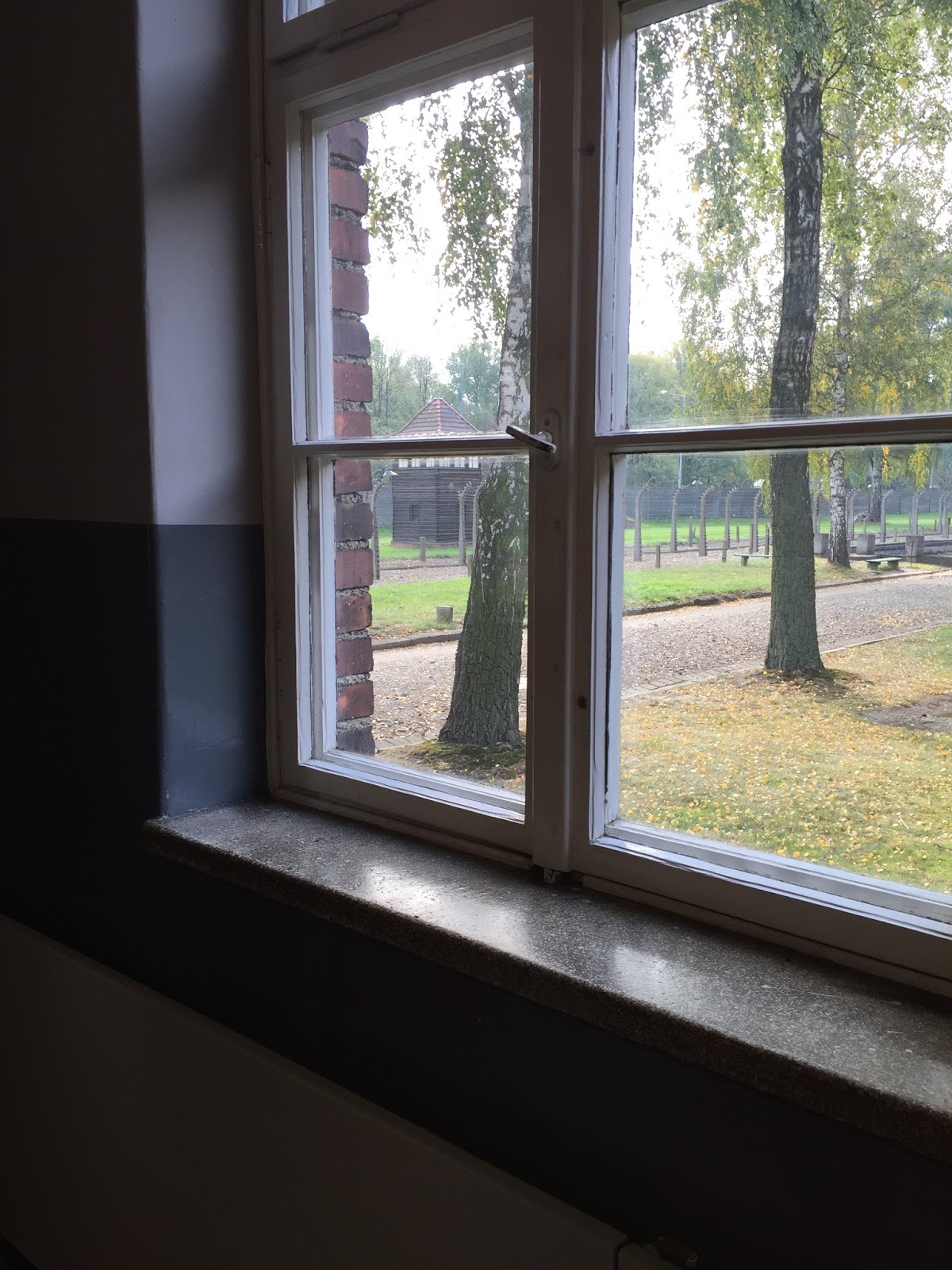
You cannot look out of the windows of the brick buildings without seeing a watchtower and feeling a trapped sensation.


You cannot look at the numbers printed on the walls without feeling a sickening tightening in your gut.


You cannot walk down the tree-lined avenues without wondering why.


You cannot step into the rooms filled with hair without thinking about the people that it all once belonged to.

You cannot walk down the corridor of shoes without smelling the stench of slowly rotting leather and wanting to vomit - and then, when you reach the window at the end, before you turn back, you are filled with despair as your gaze is met by the watchtower again.

The baby toys and infant clothing make you want to cry.

You want to scream at the tourists taking pictures of the sight where men and women were first murdered with Cyclone B that this is a place where people died, and can you not document your vacation for just one minute, please, and respect the dead.

You pass the cell where Maximilian Kolbe died, and cross yourself, and say a prayer, because you're starting to get claustrophobic in this prison and want to get out as soon as you can.


You see the wall where men and women were executed, turned into a memorial with flowers, and wonder why people can't just treat the whole place as a memorial, instead of only a single spot.


And then, just when you think you're about to be free, you walk into the gas chamber.

And now you really want to scream, because everyone around you is taking photos of the walls, the floor, the ceiling. And you can't bear to be in there, standing among the ashes of the dead (not literal ashes, because every surface has long since been wiped clean) with people who cannot fully grasp the enormity of what they're witnessing. The crematorium is a distant image for you because you just walk straight past it to get outside - the stench of death is too strong inside.

And again, you think, you're free - but you're not.

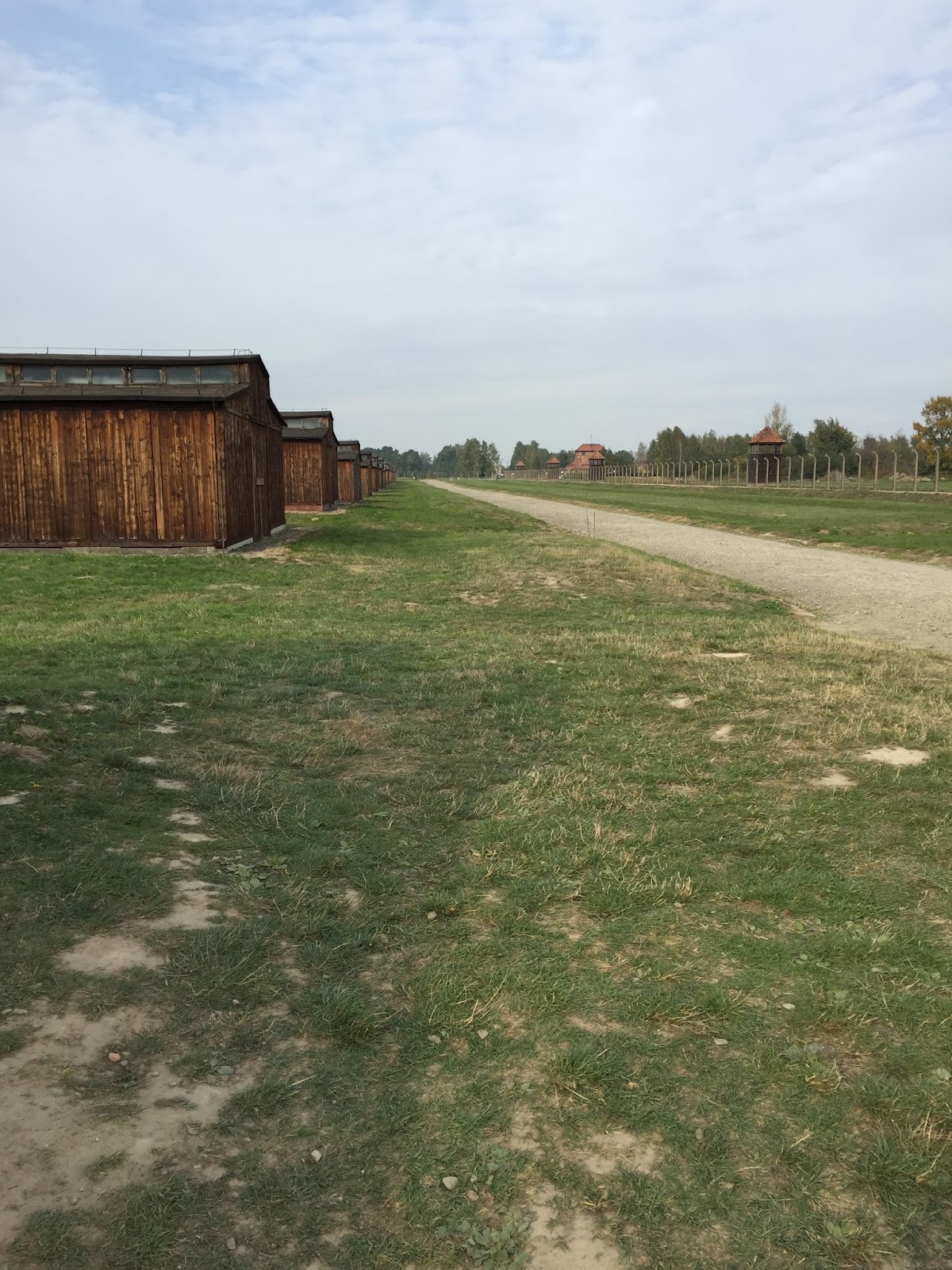
You take a fifteen minute drive to another place, just like it.

Except this one looks like it was meant to kill.


All of the structures are wood. And cattle cars and railway tracks still line the middle, dividing everything.


Half of the structures are just chimneys, because they were burned.


The ones that still stand are horrible to see.


Everyone has a need to see inside. But you can't. You've seen enough.

Enough for a lifetime.

_________________________________________________________________________________

I wasn't completely sure how I could put my experience into words, so I chose to use the second person.

The experience at Auschwitz and Auschwitz II - Birkenau is not something that I ever thought I would have, nor is it something that I ever want to experience again.

Standing on the site where so many died, I never thought I would experience so much ignorance from those around me about what they were witnessing. I heard one person ask why the Jews didn't know that they were going to prison and death camps, and why more of them didn't try to escape. I saw so many people taking selfies outside the walls, and running around laughing as if they didn't know what had happened there 70 years before. I also saw people taking photographs of the prison cells where the first tests of Cyclone B were done.

But I also saw some people who were as affected as I was. Classmates who wrote incredibly moving stories on their social media to share with their families back home once we returned, and who were incredibly solemn throughout the entire trip (and for most of the rest of the day after). The fact that other people my age realized what was going on at that site, seeing the need for the remembrance, and passed on the word to others makes me incredibly - not happy, but sort of proud of my generation.

I don't think I can ever go back to Auschwitz. The sensory overload was too great, the images too powerful, for me to undertake a return journey. I barely made it out of the first camp in one piece - adding the second camp atop that was almost too much.

The most important thing, I think, that I can bring from this experience, is to never forget the human aspect of history.

Never forget that men and women died.

It's not just the dates, the major figures, and the places on the exams - although all of those are important, too.

Remember that things like the Holocaust happened. Remember the victims.

Don't let them be forgotten.